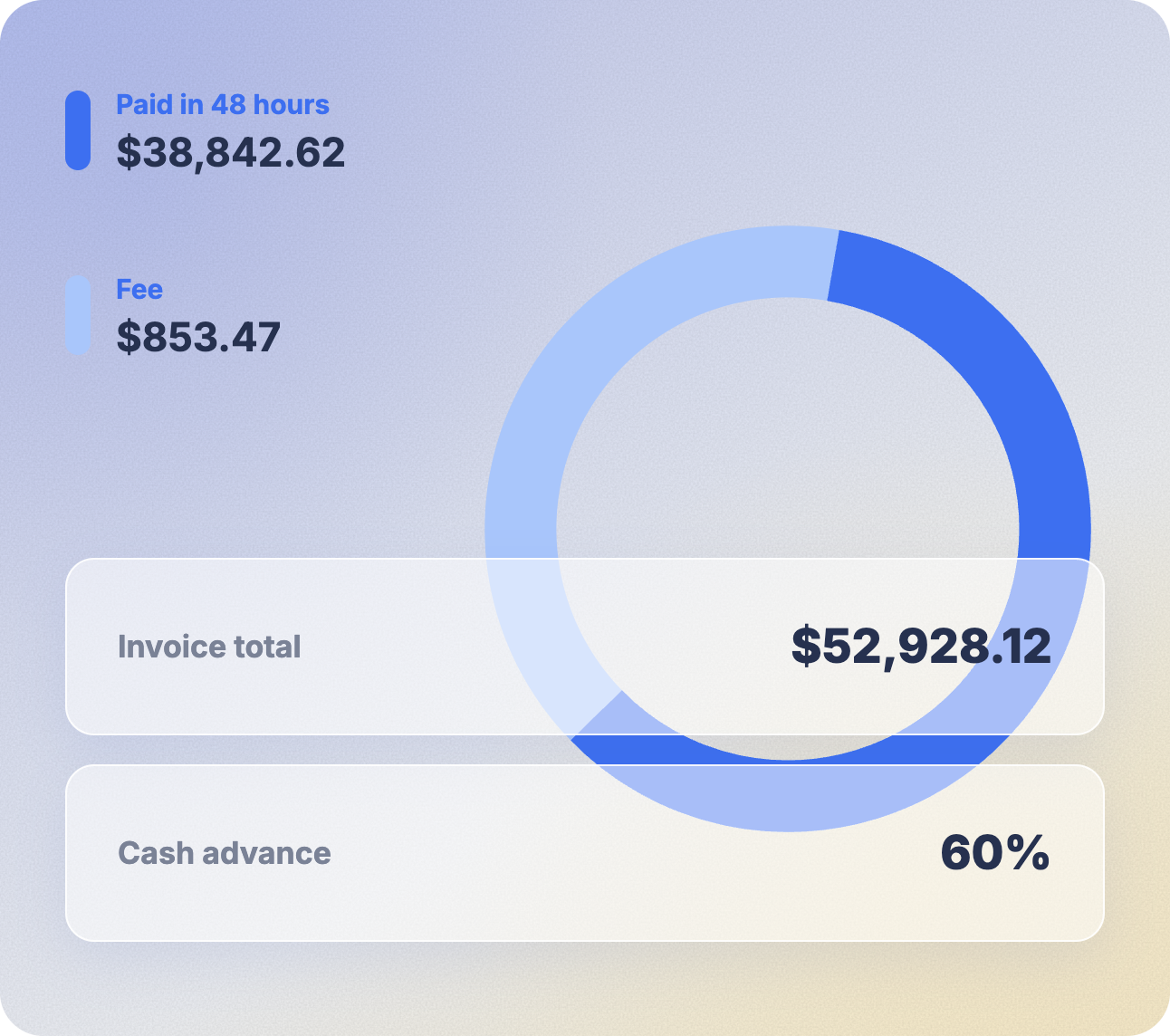
You did the work. The GC approved the invoice. And now you're waiting 60, 90, sometimes 100+ days for the money, while payroll doesn't wait for anybody. Invoice finance exists for exactly that gap: you sell an approved but unpaid invoice to a financing company for most of its value upfront, and they collect from the GC later.
Here's the part most invoice finance content skips: what it actually costs, and when it's worth it.
What it actually costs in construction
Invoice factoring in construction typically runs 2-5% per 30-day period, on the higher end of any industry, because of complex payment structures and longer collection cycles. Advance rates for construction usually land at 70-85% of the approved invoice, lower than the 90%+ common in trucking or staffing, mainly because factors won't advance against retainage. If a GC is holding 5-10% back until substantial completion, that portion doesn't get financed either, so the real advance is against the 90-95% of the invoice that isn't retainage.
Run the math before you sign anything. A sub factoring $200,000 a month against a GC on a 60-day payment pattern might pay something like 4% for the first 30 days plus another 0.5% per 15 days after that, landing around $9,000-$10,000 a month. That's real money. It's also frequently cheaper than the alternative: missed payroll, strained supplier terms, or turning down the next job because this one's cash is tied up.
Where it actually helps
It breaks the wait without you doing anything different operationally. You still bill the same way, on the same schedule. The financing company is advancing against work you've already completed and already had approved, not changing how or when you invoice.
It scales with your growth instead of against it. A bigger, more diverse client base usually gets better terms, since no single client's slow pay sinks the whole facility. That's the inverse of how most credit works for a growing sub: the bigger you get, the more financing options open up rather than close.
It lets you say yes to the next job. The subs who turn down profitable work aren't usually short on capacity, they're short on cash tied up in the last project's unpaid invoices. Financing frees that up without you taking on debt against your business itself.
Cru: Cash Flow Agent
Close the cash gap without taking on debt
Cru's Cash Flow Agent forecasts your cash position from receivables and payment history, so you can see a gap coming before it forces a factoring decision.
Book a demo →Where it doesn't help
If your problem is a bad bid, not a slow payer, financing just delays the reckoning at a fee. And if you're financing every invoice every month indefinitely rather than bridging specific gaps, the fees compound into a real drag on margin, worth comparing honestly against fixing the underlying payment terms instead.
A faster, cheaper version for the right situations
Not all invoice finance charges factoring-level fees. Constrafor's Early Pay program deposits funds within 24 hours of a signed contract, and has financed over $2B for subcontractors, structured specifically around construction payment timelines rather than a generic factoring product retrofitted for the trades.
See your cash position before you need financing
Free to connect, no commitment. See your first cash flow forecast in minutes.
Book a demoTL;DR
- Construction invoice factoring runs 2-5% per 30 days with 70-85% advance rates, both worse than other industries because of retainage and longer cycles.
- It's a tool for bridging a specific cash gap, not a permanent fix for a bad bid or bad client mix.
- The better your client diversification, the better the terms you'll get.
- Purpose-built construction financing (like Constrafor's Early Pay) tends to beat generic factoring on speed and cost.
Sources