Your office manager spends 10 hours a week chasing insurance certificates. Your bookkeeper hand-codes every invoice to the right job. Your AP person re-keys the same data into three different systems. None of that requires human judgment. All of it is exactly the kind of work software can do without you.
A subcontractor AI agent is software that executes that work on its own: reading invoices, coding transactions, chasing compliance, forecasting cash, reconciling job costs, without waiting for someone to click through every step. That's different from the construction software you already own, and it's different from a chatbot.
Agent, not chatbot, not database
Traditional construction software is a filing cabinet. You put data in, it stores it, you pull reports when you need them. It does nothing on its own.
A chatbot answers questions. Ask it something and you get text back. Useful, but it isn't processing your invoices or filing your lien waivers.
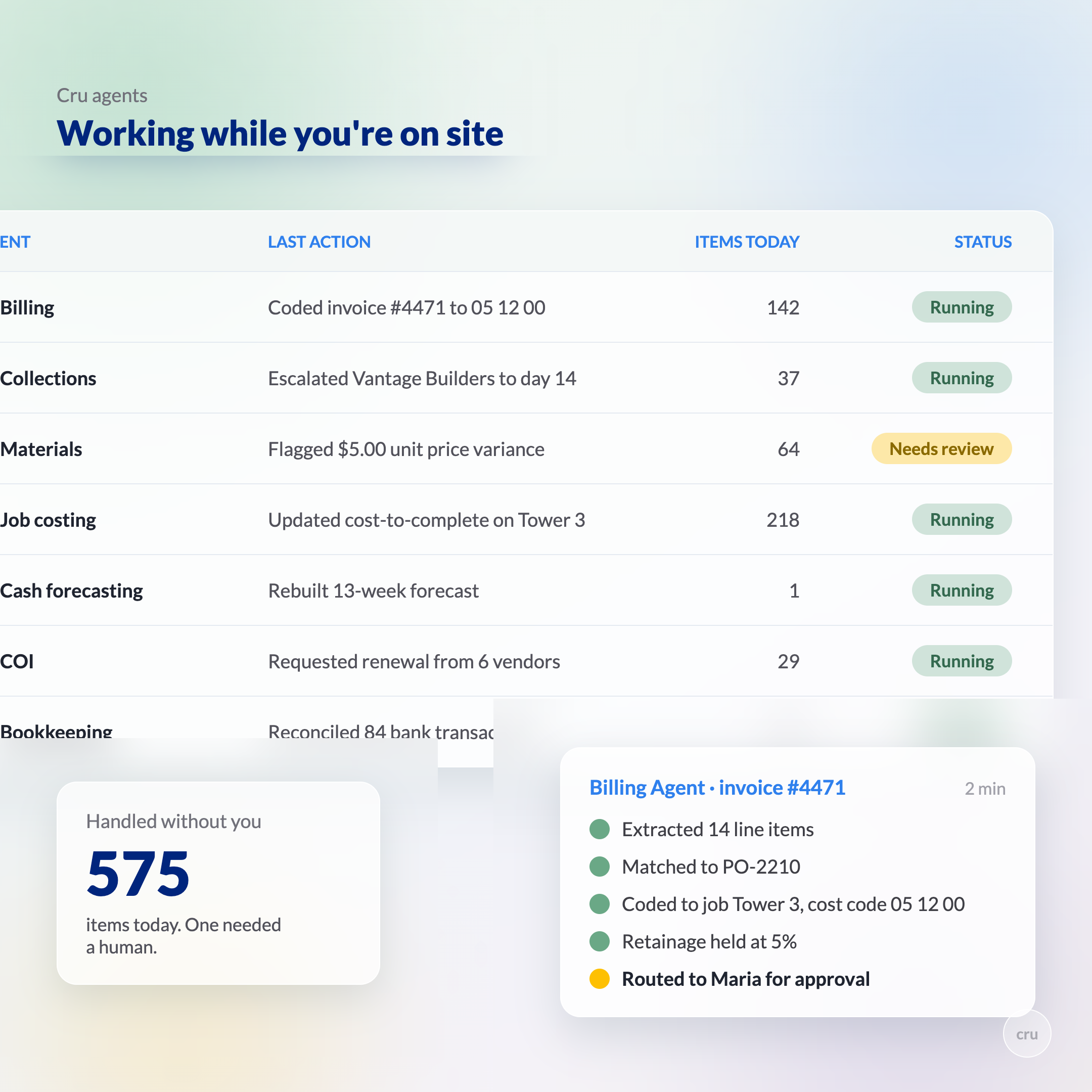
An agent does the work. It doesn't wait for you to enter an invoice, it reads the invoice, matches it to the purchase order, codes it to the right job, and routes it for approval. Chatbots talk. Agents act.
Dodge Construction Network's 2025 research on AI for contractors found 87% of contractors believe AI will meaningfully impact their business. It's past the experimental stage. The real question is which agents to deploy first.
The seven agents doing the work
Cru's AI-native platform runs seven specialized agents that share data with each other, so one event updates every connected workflow at once.
Cash Forecasting Agent models future cash position from receivables, payables, project schedules, and payment history, producing rolling 13-, 26-, and 52-week forecasts so cash pressure shows up weeks before a payroll run is at risk.
Billing Agent generates AIA-style pay applications from project progress data, tracks retainage, and manages the invoicing cycle, replacing a 10-30 minute manual process per invoice with a few minutes of automated coordination.
Collections Agent monitors receivables aging and triggers outreach at thresholds you set, working in lockstep with the Billing Agent so nothing sits unchased on a spreadsheet.
Materials Agent tracks material costs across jobs, matches invoices to quotes, and flags pricing discrepancies before they get paid, which matters more with tariff-driven price swings in 2026.
Job Costing Agent codes costs to projects as they're incurred, not at month-end, and flags budget deviations while there's still time to react.
COI Agent tracks insurance certificates, lien waivers, and permits across your entire vendor list, sends renewal requests, and escalates if a vendor doesn't respond, before a missing cert stalls a project.
Bookkeeping Agent handles ledger maintenance and bank reconciliation. A 2024 Gartner survey found 18% of accountants make financial errors at least daily, and 59% make several errors a month. This agent eliminates that error rate on routine work and surfaces anomalies for a human to review.
One transaction triggers all seven. A Billing Agent invoice with retainage held back automatically updates the cash forecast, the job margin outlook, and the collections queue. That's what "autonomous" actually means here.
What it looks like on an invoice
An invoice lands by email. The agent extracts line items, amounts, and job codes, matches it against the original PO, codes each line to the right job and cost code, and routes it for approval based on your thresholds. The whole thing happens in minutes.
It gets better with repetition, too. After 50 invoices from the same vendor, it knows their format and pricing patterns. Parseur's 2025 benchmarks put modern AI invoice extraction near 99% accuracy.
Compliance runs the same way. The COI Agent checks every certificate across your vendor list, flags one 30 days from expiration, escalates if the vendor goes quiet, and surfaces a gap to the project manager before the GC does. No spreadsheet. No calendar reminder. No awkward call asking for an updated COI.
Cru: Bookkeeping Agent
Eliminate the errors that come from manual bookkeeping
Cru's Bookkeeping Agent handles ledger maintenance and bank reconciliation automatically, and surfaces anomalies for a human to review instead of missing them.
Book a demo →Does it actually save time
Cru customers report saving 10+ hours a week on admin work, roughly a full-time employee's worth, redirected to the field. 91% would recommend Cru to another subcontractor owner, and 85% use it daily, which is a better signal than the hours-saved number alone: people only open software daily if it's actually solving something.
The compounding part matters more than any single stat. Hours saved in month one mean a clearer cash view in month two. A clearer cash view means better bids in month three. Better bids mean stronger margin on the next job.
Getting started without drowning in it
Don't automate everything on day one. Start with the highest-volume repetitive task, usually AP and invoice processing. Once that's running clean, add compliance tracking, then job costing, then collections. A realistic timeline for a 50-person specialty sub: weeks 1-2 connect your accounting software and let the Billing Agent shadow your existing process; weeks 3-4 hand it the full workflow and shift your AP person to exceptions only; month 2 add the COI Agent; month 3 layer in job costing.
Look for four things before you commit to a platform: construction-specific training (a generic AI tool doesn't understand AIA billing or retainage), integration with what you already run (QuickBooks, Sage, Foundation, Procore, Textura, GCPay), a low learning curve for a team that isn't made of software engineers, and transparent decision-making, meaning you can see why an invoice got coded the way it did.
TL;DR
- An AI agent acts on your data. A chatbot answers questions about it. Traditional software just stores it.
- Cru runs seven agents (cash forecasting, billing, collections, materials, job costing, COI, bookkeeping) that share data and trigger each other.
- Modern AI invoice extraction runs close to 99% accuracy, and it gets sharper with each vendor it learns.
- Start with one process, usually AP, prove it out, then expand.
Sources
- Dodge Construction Network's 2025 research on AI for contractors
- A 2024 Gartner survey found 18% of accountants make financial errors at least daily, and 59% make several errors a month
- Parseur's 2025 benchmarks put modern AI invoice extraction near 99% accuracy
Put seven agents to work on your back office
Free to connect, no commitment. See your first cash flow forecast in minutes.
Book a demoThe bottom line for construction subcontractors
AI agents are not futuristic technology. They are production-ready tools that construction subs are using right now to cut administrative hours, reduce errors, and protect their margins.
The subs that adopt early get a compounding advantage. Every month of cleaner data, faster payments, and fewer compliance gaps adds up.
Start with one agent. Automate one process. See the results. Then decide how far you want to go.
Explore Cru by Constrafor and see how the seven agents work together to handle your back office end-to-end.