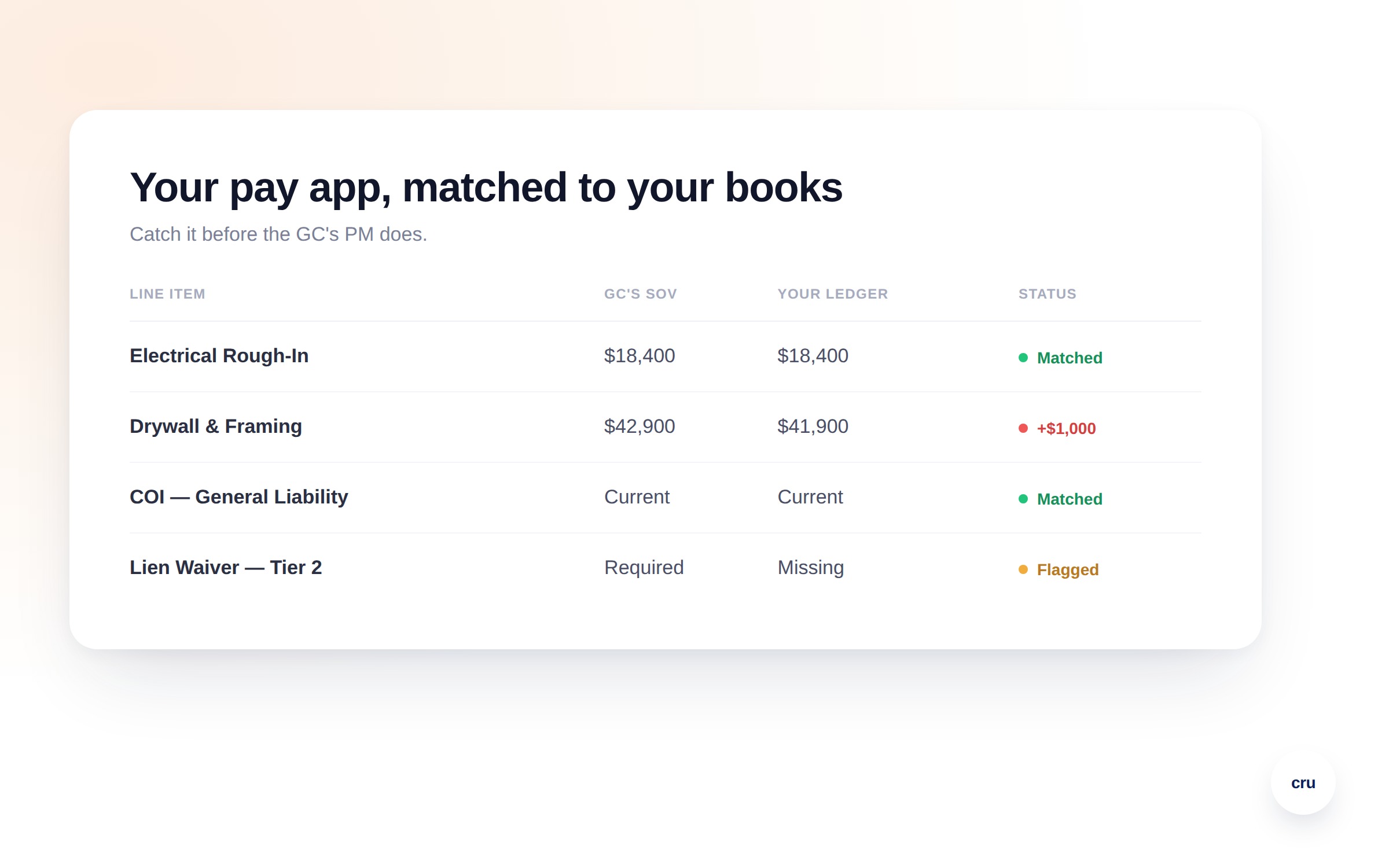
You resubmit the same pay app for the third time this month, and the GC's PM still finds something wrong with it.
This time it's not even the numbers. It's that your lien waiver references last month's payment amount instead of this month's, and the schedule of values line for "electrical rough-in" doesn't match what the GC's spreadsheet calls "electrical, phase 1." Small stuff. Except small stuff is exactly what a GC's accounting team is trained to bounce back, no explanation required beyond "resubmit corrected."
Here's the quiet part: a pay application rejection isn't really about your paperwork. It's a free option the GC holds over your cash. Every kickback resets the clock on a payment cycle that was already 60, 90, or more days out, and it costs the GC nothing to send it back. You eat the delay, the redo, and the awkward call to your bookkeeper asking why the money still isn't in the account.
The rejection reasons are boring, and that's the problem
Nobody gets their pay app kicked back for a dramatic reason. It's almost always one of four unglamorous things:
- Schedule of values mismatch. Your line items don't map cleanly to the GC's cost codes, or a change order hasn't been reflected in both places yet.
- Missing or incorrect lien waivers. Wrong amount, wrong period (conditional vs. unconditional), or missing a lower-tier waiver from a sub-sub.
- Expired or incomplete COIs. A certificate that lapsed mid-project, or additional-insured language the GC's insurance team didn't sign off on.
- Backup documentation gaps. No photos, no signed time-and-material tickets, no updated retainage calc.
None of these are hard problems on their own. The problem is that they live in different files, get updated by different people, and nobody catches the mismatch until the GC's accounts payable team does, on their schedule, not yours.
Every rejection is a full cycle, not a quick fix
The math here is the part that doesn't show up on a punch list. A rejected pay app doesn't get corrected and reinserted at the front of the queue. It usually goes back to the end of the next billing cycle. If your GC bills monthly and your pay app gets kicked back on day 3 of their 10-day review window, you're not losing 3 days. You're often losing the rest of that cycle, plus however long the next one takes, because most GC contracts and payment terms run net 30 to net 60 from an approved application, not a submitted one.
Only 52% of contractors report getting paid within 30 days of invoicing, and industry-wide days sales outstanding in construction runs close to 83 days, nearly three months, according to Levelset's national payment research. A single rejected pay app can be the difference between landing inside that window and falling well outside it. Levelset's data also found 23% of contractors cite missing or incorrect documentation as a primary reason payment falls behind, which lines up with what most subcontractor controllers already know in their gut: it's rarely the work that's in dispute, it's the paperwork trailing it.
Lien waivers are the single most common trip wire
Of all the reasons a pay app comes back marked "incomplete," lien waivers cause a disproportionate share of the pain, because they require coordination with people outside your own office: your sub-subs, your suppliers, sometimes a bonding company. Siteline, which builds billing software for subcontractors, reports that firms using automated waiver collection cut roughly 7 days a month off the manual chase, which is a rough proxy for how much time that chase costs when it's still running on email and PDFs. That's not overhead you can staff your way out of with one more spreadsheet tab. It's a coordination problem, and coordination problems are exactly where a rejection cycle starts.
Where the schedule of values quietly breaks
The schedule of values (SOV) is supposed to be a shared document. In practice, most subs keep their own version in QuickBooks or a spreadsheet, and the GC has their own version inside Procore, Textura, or a proprietary billing portal. Every change order, every re-sequenced scope, every "let's just call it one line item" conversation creates a small drift between the two versions. That drift is invisible until the GC's reviewer lines your pay app up against their SOV and the numbers don't tie out. Then it's back to you, marked "resubmit," with no detail on which line caused the flag.
Cru: Bookkeeping Agent
A pay app that matches your books before it ever leaves your office
Cru's bookkeeping agent keeps your schedule of values, change orders, and billed-to-date numbers reconciled against your ledger in real time, so the version you send a GC is the same version your own books already agree with. It's the entry point to Cru, $500 a month flat, every agent included, no per-agent fees.
Book a demo →COIs expire quietly, and GCs notice loudly
Certificates of insurance are the rejection reason nobody budgets time for, because a COI doesn't fail because you did something wrong. It fails because a renewal date passed while everyone was focused on the actual job. A GC's insurance compliance software flags an expired COI automatically and holds your entire pay application hostage to it, even when the rest of your submission is clean. One expired page can freeze a six-figure draw.
What a rejection actually costs, in days and dollars
Stack a few of these together and the pattern is obvious: it's rarely one big problem, it's three or four small ones landing in the same billing cycle. A mismatched SOV line, a waiver with last month's number on it, a COI that lapsed two weeks ago. Each one is a five-minute fix. Each one also means missing that cycle's submission deadline, which on a net-45 or net-60 contract can mean the difference between cash in 45 days and cash in 90. For a subcontractor carrying payroll, materials, and second-tier sub payments in the meantime, that gap isn't paperwork. It's financing you didn't sign up to provide.
What actually stops the resubmission loop
The fix isn't "be more careful." Careful doesn't scale past your third active project. What stops the loop is having one system where your schedule of values, your lien waiver status, your COI expiration dates, and your actual ledger all agree with each other before you hit submit, instead of living in four places that only get compared after a GC rejects you. That's a process change, not a willpower change.
What this doesn't fix
No agent or software fixes a GC that rejects pay apps for reasons that have nothing to do with your paperwork, slow-pay as a cash management strategy, or a project that's genuinely in dispute over work quality. Clean documentation gets you a fair shot at the payment terms you're owed. It doesn't force a GC to move faster than their own AP department wants to.
Where this fits next to what you're already using
Cru's bookkeeping agent works alongside Procore, Textura, or whatever billing portal your GCs already require you to use for submission, it doesn't replace those portals. Think of it as the layer that keeps your internal numbers correct before they ever get typed into someone else's system. The free COI agent, included on every plan, watches certificate expirations and renewal timing separately, so that problem doesn't sneak up on a pay app either.
See what a clean pay app looks like before you submit it
Free to connect, no commitment. See your first cash flow forecast in minutes.
Book a demoTL;DR
- Only 52% of contractors get paid within 30 days of invoicing, and industry-wide days sales outstanding runs close to 83 days.
- 23% of contractors point to missing or incorrect documentation as a primary reason payment falls behind.
- Automating lien waiver collection alone has been shown to cut roughly 7 days a month off the manual chase for waivers across tiers.
- The four most common rejection triggers are schedule of values mismatches, incorrect lien waivers, expired COIs, and missing backup documentation.
- A single rejected pay app usually costs a full billing cycle, not a few days, since resubmissions typically queue behind the next cycle's deadline.
Stop resubmitting, start reconciling automatically →