Somewhere right now, an invoice you sent six weeks ago is sitting in someone's approval queue, and payroll is due Friday.
The average subcontractor waits 60 to 90 days to get paid. Lower-tier subs wait 100 or more. That's three months of payroll, materials, and overhead you've already funded, out of your own pocket, before the GC's check shows up.
Here's the part worth saying plainly: some of that wait is baked into how construction billing works. Progress billing, retainage, multi-tier payment chains, none of that is going away. But a real chunk of the delay is just paperwork and process, and that part is fixable.
What the wait actually costs
Late payment cost the construction industry $299 billion in 2025, which works out to something like a 14% hidden tax on every project. It shows up as missed payroll, strained supplier accounts, and crews standing around waiting on a check that should've cleared weeks ago.
Since 2019, subcontractors dipping into retirement savings to keep the business running is up 147%. That's not a cash flow hiccup. That's people cashing out their future to cover a GC's slow AP department.
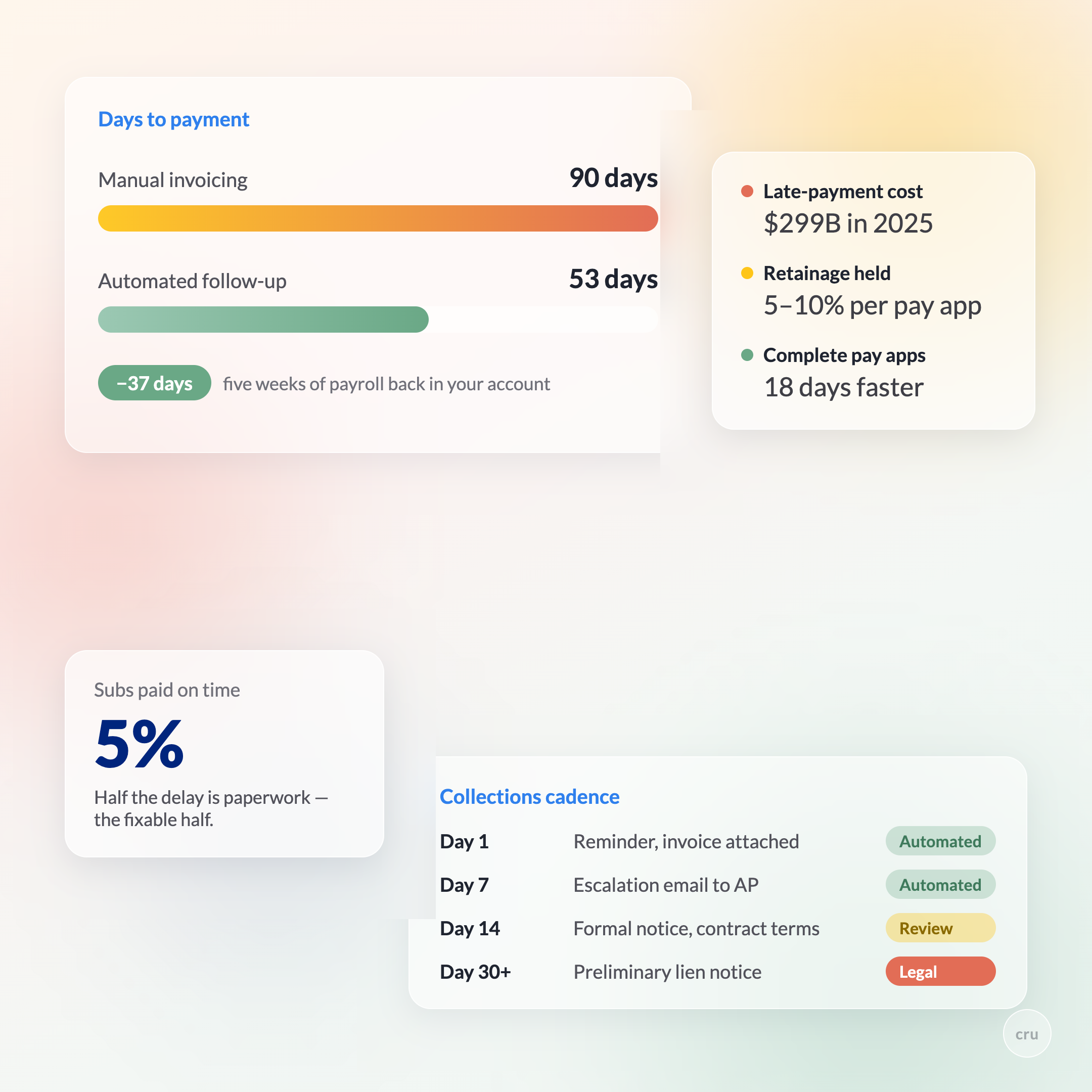
Subs on modern billing systems are getting paid in 53 days instead of 90. That gap, roughly five weeks, is the whole ballgame.
Why it happens
Split the causes into two buckets: the ones you can't control, and the ones you can.
Structural. Progress billing creates a built-in lag between finishing work and getting to invoice for it. Retainage holds back 5–10% of every payment, sometimes for years. Money moves owner → GC → sub → supplier, so any delay upstream lands on you last. And "pay-if-paid" clauses still let some GCs withhold payment entirely if the owner hasn't paid them, even in states that have started declaring the clauses void.
The law is catching up, slowly. California's SB 61 caps retention at 5% on most private projects starting in 2026. New York amended its Prompt Payment Act to void any contract clause demanding more than 5% retainage. Know what your state actually allows before you sign, not after.
Operational. This is the fixable half, and it's most of the problem: incomplete pay applications, missing lien waivers or COIs, submissions that land a day after the cutoff and get bumped to the next cycle. A missing signature costs you 30 days just as surely as a legal dispute does.
Cru: Collections Agent
Get an automated follow-up cadence on every invoice
Cru's Collections Agent runs the day 1, 7, 14, and 30 follow-up cadence automatically, so nothing sits unchased for three weeks.
Book a demo →What actually gets you paid faster
Before you sign: Check the GC's payment history before you bid, not after. Tools like Levelset's Risk Intelligence show average days-to-pay and dispute history for a given GC, so you know what you're walking into. Negotiate Net 30 instead of accepting Net 60 by default, and price your working capital cost into the bid, subs who do this run 24% margins versus 17% for subs who don't. And know your state's retainage caps before you need them.
During the project: Complete pay applications get paid 18 days faster than incomplete ones. Attach every lien waiver, continuation sheet, and change order up front, don't make the GC ask for what should already be there.
With technology: Digital pay-app platforms cut processing time 62% and disputes 41% versus paper. And automated collections follow-up works, 75% of companies using it report cutting their days-sales-outstanding by six or more, simply because nothing sits unfollowed for three weeks waiting for someone to remember to call.
A follow-up cadence that actually works
95% of subcontractors do not get paid on time. Most of the fix is just consistency:
- Day 1 past due: automated reminder, invoice attached
- Day 7: call or escalation email to AP
- Day 14: formal notice citing the contract's payment terms
- Day 30+: preliminary lien notice or a call to your attorney
Automate the first two touches. Save a human for the escalated ones. Keep a record of everything, it's the paper trail you'll need if this ends up in a legal remedy.
84 Lumber cut postage costs by more than half, from $12–13K to $5–6K a month, just by switching to digital invoicing and automated payment reminders. They're now handling more credit volume with the same headcount.
When you need legal teeth
Mechanics liens put a legal claim against the property itself, follow your state's filing rules to the letter, since a missed step can make the whole thing unenforceable. New York gives you six years from the due date to bring a contract-based payment dispute. Prompt payment act claims vary by state, but often include mandatory interest on late payments and hard caps on retainage. A growing number of states are also restricting pay-if-paid clauses outright, following the lead of jurisdictions like Australia, where the law simply doesn't let GCs enforce them.
Bridging the gap until the check clears
Even with clean process, you'll still have gaps between spending money and getting paid. Three ways to close it: invoice factoring gets you 80% of an approved invoice in 24–48 hours for a 1–3% fee. Early pay programs, like Constrafor's, deposit funds within 48 hours of a signed contract. And some GCs run accelerated payment programs that pay within five business days if your compliance is current.
Stop chasing payment by hand
Free to connect, no commitment. See your first cash flow forecast in minutes.
Book a demoTL;DR
- The average sub waits 60–90 days to get paid; modern billing systems get that down to 53.
- Late payment cost the industry $299B in 2025, and retirement-account withdrawals by subs are up 147% since 2019.
- Half the delay is structural (retainage, progress billing); half is fixable paperwork (incomplete pay apps cost you 18 days, easy).
- A simple day 1/7/14/30 collections cadence, mostly automated, closes most of the gap.
- Bridge what's left with factoring, early pay, or accelerated GC programs.
Cru's Collections Agent runs that follow-up cadence automatically, so nothing sits unchased for three weeks. See how it works →