Most prequalification packets don't get rejected for being unqualified. They get bounced for being incomplete or out of date.
Prequalification is the gate every sub has to clear before a GC will even consider them for bid, and the frustrating part is that the reasons packets get sent back rarely have anything to do with whether the company is actually a good fit for the work. It's a missing document, a stale financial statement, or an entity name on the insurance certificate that doesn't quite match the one on the application. None of that is complicated to fix — it's just tedious enough that people get it wrong under deadline pressure. Here's what's typically required and where the process actually breaks down.
What a typical prequalification packet asks for
Financial statements. Most GCs want two to three years of financial statements, sometimes CPA-reviewed or audited depending on project size, plus a current-year interim statement if the fiscal year-end is more than a few months back. Bonding companies and larger GCs often want a work-in-progress schedule alongside it.
Safety record and EMR. Your Experience Modification Rate along with OSHA 300 logs for the past three years. A rate above 1.0 doesn't automatically disqualify a sub, but it invites more scrutiny and sometimes a written explanation of corrective action taken.
Bonding capacity. A letter from your surety stating single-project and aggregate bonding capacity, plus your current bonded backlog. GCs use this to gauge whether you can actually carry the work alongside everything else on your plate.
References. Usually three to five recent, similar-scope projects with a live contact at each — not just a project name and address. GCs do call these, and a reference who can't be reached or doesn't remember the project reflects worse than a mediocre reference who answers.
Insurance and licensing. Current certificates of insurance matching the limits and endorsements the GC requires, plus active license documentation in the state and trade classification the work falls under.
Cru: COI Compliance Agent
Keep your insurance and financials current before a GC asks
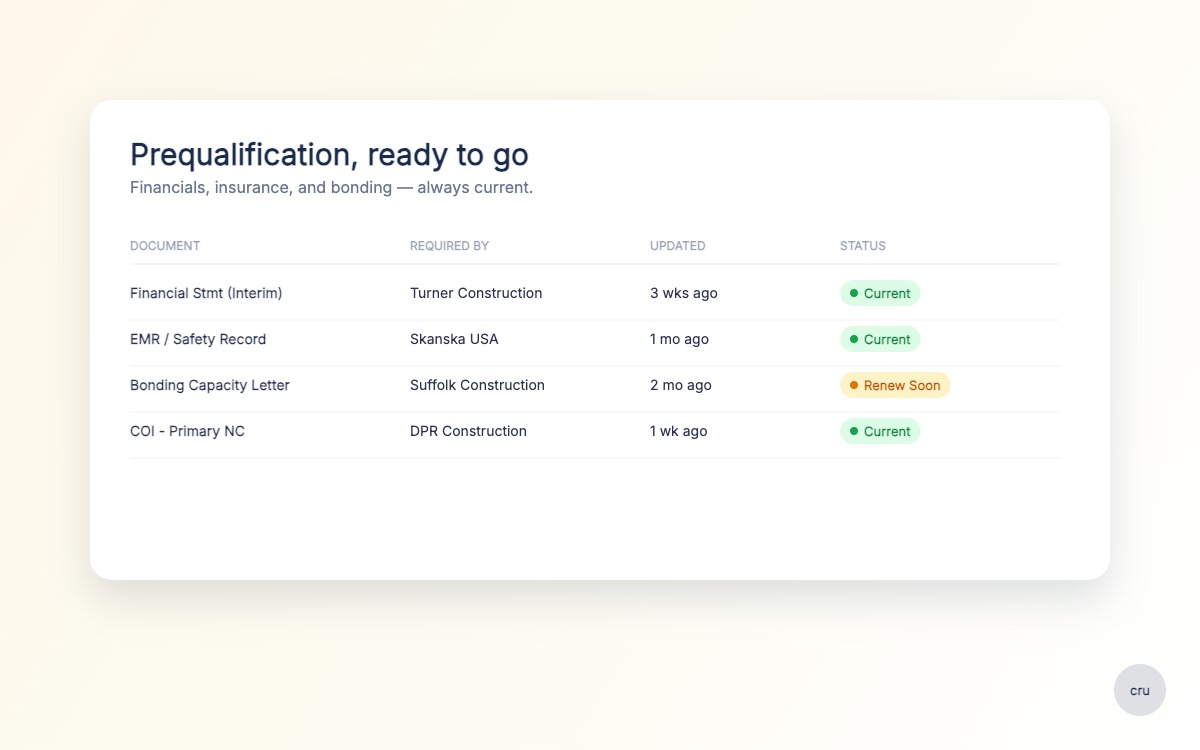
Cru centralizes financials, certificates of insurance, licensing, and bonding data in one place, so a fresh prequalification packet is a reassembly, not a scramble.
Book a demo →Where packets actually get bounced back
Missing documents, not missing qualifications. The single most common reason for a rejection is an incomplete submission — a required attachment left out, a signature page skipped, a reference contact left blank. Reviewers process a high volume of these and don't chase down missing pieces; they send the whole thing back.
Stale financials. Submitting a financial statement from eighteen months ago because it's the most recent one on file is a common miss. If your fiscal year closed six-plus months ago, most GCs expect an interim statement bridging the gap, not just last year's year-end.
Entity name mismatches. The legal entity name on the application, the insurance certificate, the license, and the bonding letter all need to match exactly. A DBA on one document and the LLC name on another is a small clerical issue that still gets flagged and sent back.
Inconsistent numbers. Revenue or backlog figures that don't reconcile between the financial statement and the bonding letter raise a flag even when both numbers are individually accurate — reviewers read that as a documentation control problem.
What still needs a human
A checklist keeps you from missing a document, but it doesn't write your financial narrative, negotiate bonding capacity with your surety, or explain a bad year to a GC's risk department. Prequalification review is ultimately a judgment call made by a person on the other end, and no amount of document automation replaces having your CPA and bonding agent genuinely up to date on your numbers before you submit.
How subs manage this today
Most subs handle prequalification with a shared drive folder and a memory of what was submitted last time, updated ad hoc when a new bid comes up. Larger subs sometimes maintain a master document library so packets can be assembled faster per GC. Tools that centralize financials, insurance, licensing, and bonding data in one place — rather than scattered across an accountant's inbox, a broker's portal, and a shared drive — make reassembling a fresh, current packet for each new GC faster and reduce the odds of submitting something stale.
Never submit a stale prequalification packet again
Free to connect, no commitment. See your first cash flow forecast in minutes.
Book a demoTL;DR
- Packets typically need financials (2-3 years plus interim), EMR/safety record, bonding capacity letter, 3-5 live references, and current insurance/licensing.
- Most rejections are for missing documents or incomplete submissions, not for being unqualified.
- Stale financials — submitting last year's statement when six-plus months have passed — is one of the most common and avoidable misses.
- Entity name mismatches across application, insurance, license, and bonding documents get flagged even when everything else is accurate.
- Keeping financials, insurance, and licensing data current and centralized in one place cuts the time to assemble a clean packet for each new GC.