Every invoice financing pitch sounds the same: fast funding, simple process, competitive rates. The differences that actually matter live in places most subs don't ask about until after they've signed.
Understanding Invoice Finance
Invoice finance is a financial arrangement where a business sells its unpaid invoices to a third party usually a finance provider in exchange for a significant percentage of the invoice's value upfront. The provider later collects the full invoice amount from the customer, taking a small fee in return.
For growing businesses, this solution bridges the cash flow gap caused by delayed payments, ensuring funds are available to fuel expansion, pay suppliers, and meet day-to-day operational needs.
Role of Business Growth in Enhancing Invoice
When your business is on an upward trajectory, invoice finance can become more than just a cash flow tool—it can become a growth accelerator. Here’s why:
- Lower fees due to economies of scale
- More flexible repayment terms
- Higher advance rates
Ask about recourse before you ask about the rate
Recourse factoring means if your customer doesn't pay within the recourse period, usually 60-90 days, you buy the invoice back. Non-recourse means the financing company eats that loss instead, for a higher fee. Most providers quote recourse rates by default because they're lower, which makes the headline number look better than the actual risk you're taking on. Ask directly which one you're being quoted, and price the difference before comparing offers side by side.
Find out if your GC will be notified
Notification factoring tells your customer the invoice was sold. Non-notification keeps you collecting as usual, invisibly to the GC. If you'd rather not have this conversation with a client relationship you're trying to protect, confirm which model a provider uses before you sign, not after your GC gets a call from a factoring company they've never heard of.
Check whether retainage kills your real advance rate
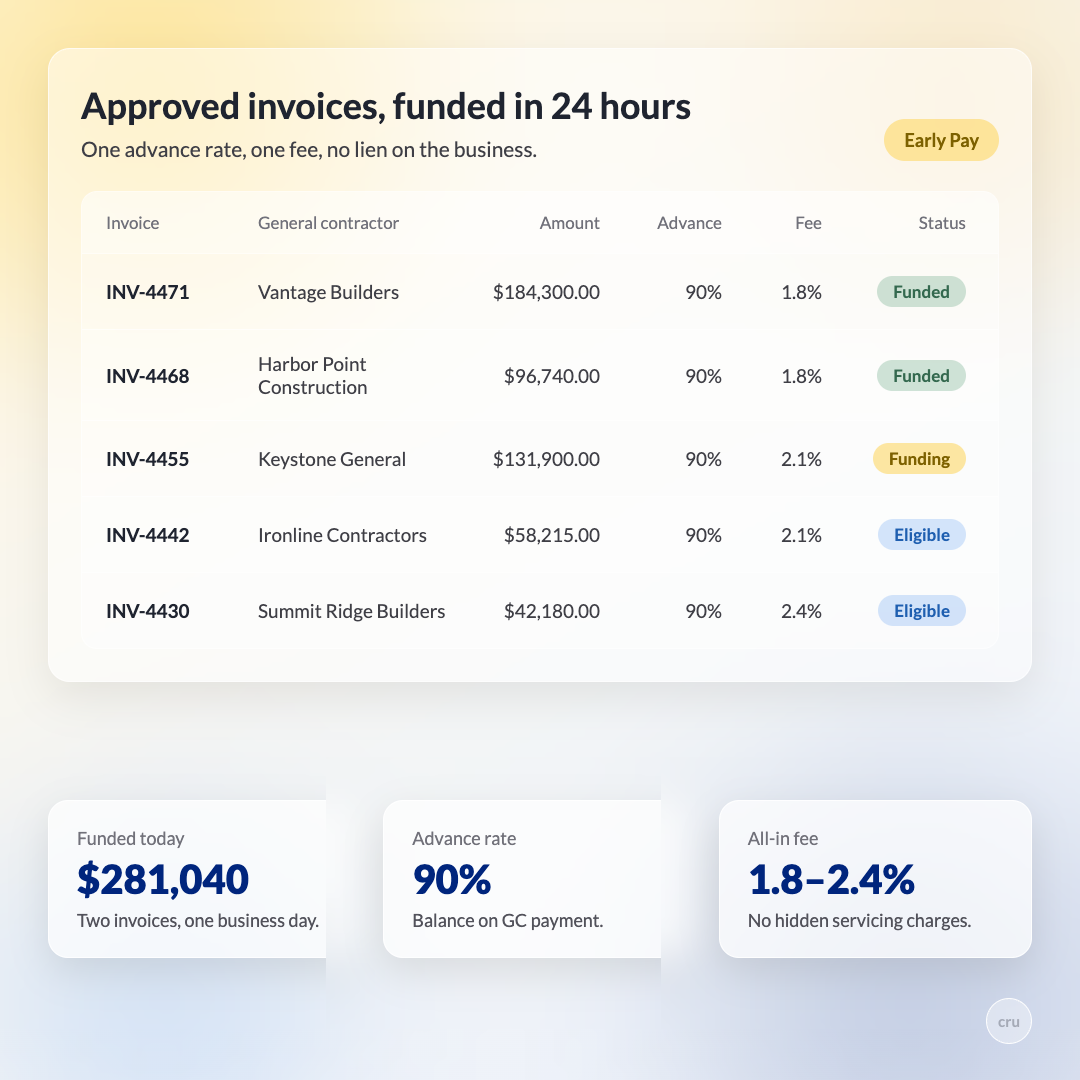
Construction advance rates typically run 70-85% of the approved invoice, lower than other industries because most financing companies won't advance against retainage. If a GC holds 5-10% back until substantial completion, that portion is off the table regardless of what advance rate is advertised. Ask specifically how retainage is handled, since a "90% advance rate" on paper can turn into a real 80% once retainage is excluded.
Cru: Cash Flow Agent
Know your real advance rate before you compare providers
Cru's Cash Flow Agent tracks retainage and payment timelines by GC automatically, so you can see the real numbers before a financing partner quotes you their best-case ones.
Book a demo →Run the actual monthly cost, not just the headline fee
Construction factoring fees run 2-5% per 30-day period, and providers often quote the low end of that range while structuring fees to compound past 30 days if your GC is a slow payer. A sub factoring $200,000 a month against a 60-day payer might see a quoted 4% turn into something closer to $9,000-$10,000 a month once the extra-day fees layer on. Ask for a worst-case monthly cost example using your actual GC's typical payment timeline, not a generic best-case scenario.
Ask if they actually understand construction
A generic invoice financing company underwrites based on generic AR aging. A construction-specific provider understands progress billing, retainage schedules, and the difference between a disputed pay app and a legitimately unpaid one. That difference shows up in how fast you get approved and how the provider reacts the first time a GC delays payment for a normal, construction-specific reason rather than treating it as a red flag.
Confirm the funding timeline in writing
"Fast funding" means different things to different providers. Some fund in 24-48 hours from approval. Others take a week the first time while they set up your account, then speed up later. If your cash need is immediate, get the actual timeline in writing for your first transaction, not just the steady-state number quoted in the sales pitch.
Compare invoice financing offers with your actual numbers
Free to connect, no commitment. See your first cash flow forecast in minutes.
Book a demoTL;DR
- Recourse vs. non-recourse and notification vs. non-notification matter more than the headline rate. Ask about both directly.
- Retainage often turns an advertised advance rate into a lower real one. Confirm how it's handled.
- Get a worst-case monthly cost example based on your actual GC's payment timeline, not a best-case estimate.
- A construction-specific provider handles retainage and disputed pay apps differently than a generic one, and that difference matters the first time something goes sideways.
Constrafor's Early Pay is built specifically around construction payment timelines, funding within 24 hours of a signed contract. See how it works →