Generic bookkeeping advice tells you to reconcile weekly and categorize expenses. It doesn't tell you what to do when your wire order costs 12% more than it did when you bid the job.
Electrical subcontracting has a back-office profile that doesn't look like most other trades. Material spend is concentrated in a small set of commodities — wire, conduit, panels, switchgear — where copper pricing swings can move a job's material cost meaningfully between bid and buyout. Jobs run across multiple GCs simultaneously, each with its own billing cycle and change order process. And change orders themselves are a bigger share of total billing than in trades with more static scopes, since electrical scope shifts constantly as other trades' work gets finalized around it. Generic bookkeeping practices built for a business with stable costs and one customer at a time don't map cleanly onto that.
Where the pain actually shows up
Material price volatility eats margin invisibly. A bid built on wire pricing from eight weeks ago can be materially wrong by the time material actually gets ordered, especially on longer jobs where COMEX copper has moved in the interim. Without job costing that flags the variance between bid material cost and actual purchase cost in near real time, that erosion doesn't show up until the job's final numbers come in — by which point there's nothing to do about it.
Multi-GC job juggling fragments cash flow visibility. An electrical sub running four or five active jobs across different GCs is tracking different billing cycles, different retainage terms, and different payment histories simultaneously. Bookkeeping that treats this as "one AR ledger" instead of job-by-job, GC-by-GC visibility misses which specific relationship is actually the slow payer dragging on cash.
Change-order-heavy billing creates a documentation backlog. Because electrical scope shifts as other trades finalize their work, change orders pile up mid-job rather than getting resolved cleanly at milestones. Each one needs its own cost backup, GC approval trail, and updated contract value — and if that paperwork lags behind the actual work, the pay application undercounts what's actually owed.
Cru: Bookkeeping Agent
Flag material cost overruns while the job is still open
Cru tracks budgeted versus actual material and labor cost per job and per GC, so copper swings and change orders show up before closeout, not after.
Book a demo →What automated bookkeeping actually changes
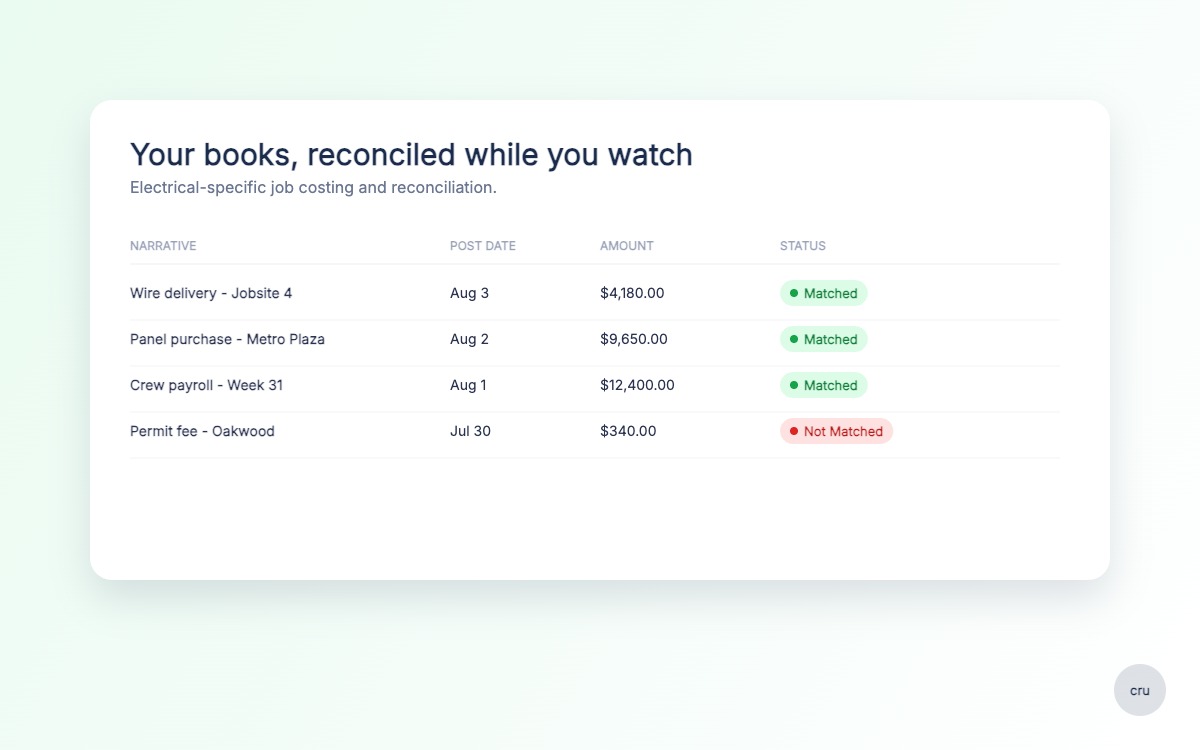
Real-time job costing against bid assumptions. Instead of finding out at closeout that material ran over, automation flags the variance between budgeted and actual material cost as purchase orders get entered, while there's still time to adjust billing or renegotiate scope on the remaining work.
Per-GC, per-job cash visibility. Rather than one blended AR number, automated bookkeeping breaks receivables out by GC and project so it's clear which relationship is actually driving a cash crunch — useful both for collections prioritization and for deciding which GCs are worth bidding again.
Change order tracking tied to billing. Automation can link each change order's cost backup and approval status directly to the next pay application, so unbilled approved COs don't sit forgotten while the next draw goes out short.
Faster close. Automated categorization and reconciliation across multiple concurrent jobs cuts the manual data entry that otherwise falls on one overworked bookkeeper trying to keep five jobs' books current at once.
What still needs a human
Automation won't negotiate material pricing with your supplier, decide whether to eat a cost overrun or push back on a GC, or make the call on which slow-paying GC is still worth bidding again. It also won't catch a change order that never got submitted for approval in the first place — someone in the field still has to document scope changes as they happen. Cru's bookkeeping tools are built to keep the numbers current and visible; the calls on pricing, collections strategy, and GC relationships stay with the owner.
Where this fits next to what electrical subs use today
Many electrical subs run QuickBooks or a similar general ledger with job costing bolted on manually, which works for straightforward jobs but strains under multi-GC, change-order-heavy billing since the reconciliation between contract billing and GL entries is manual. Trade-specific ERP systems solve more of this but are often priced and built for larger shops. Cru's approach is to automate the AR/AP/job-costing layer directly against your existing accounting system rather than requiring a full ERP replacement.
Keep job costing and AR current across every GC
Free to connect, no commitment. See your first cash flow forecast in minutes.
Book a demoTL;DR
- Electrical bookkeeping's real pain points are material price volatility, multi-GC job juggling, and change-order-heavy billing — not generic cash flow advice.
- Real-time job costing catches material cost overruns while there's still time to act, instead of at closeout.
- Per-GC AR visibility identifies which specific relationship is actually driving a cash crunch.
- Change orders need cost backup and approval tracking linked directly to the next pay application, or approved work goes unbilled.
- Automation speeds up the numbers; pricing negotiations, collections calls, and GC relationship decisions still need a human.
See how Cru's Bookkeeping Agent keeps job costing and AR current across every GC →