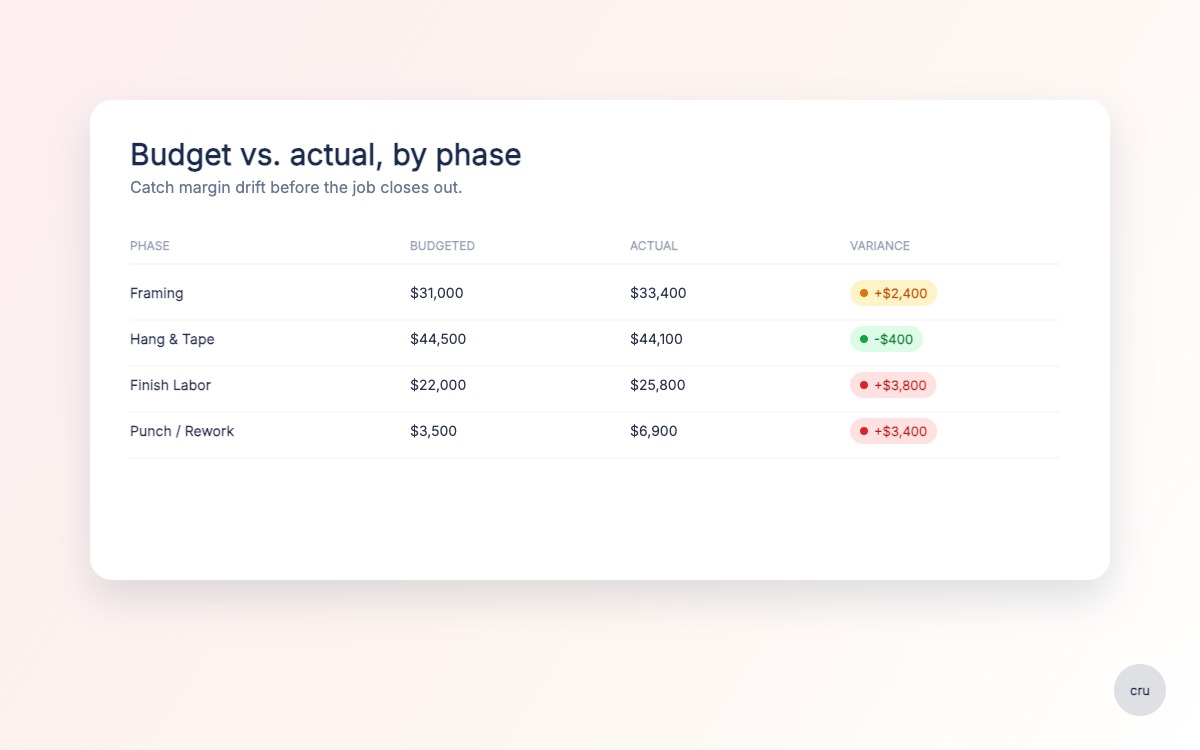
The bid said 12% margin. The closeout report says 3%, and by the time you see it, the crew's already off to the next job.
Drywall is one of the thinnest-margin trades in the business, and it's thin by design: material costs are commoditized, labor is the real cost driver, and the trade is bid competitively enough that there's very little room for the small stuff to go wrong. The problem is the small stuff always goes wrong — waste factors run hot, framing labor drifts off the estimate, punch-list rework eats hours nobody budgeted, and change orders get performed weeks before they get billed, if they get billed at all. None of it shows up as one big loss. It shows up as half a point here, a point there, until a job that looked fine at bid closes out barely breaking even.
Where the margin actually leaks
Board, mud, and tape waste factors are usually estimated at somewhere around 5-10% over the measured square footage, but real waste on a job with complex ceiling details, multiple room configurations, or a crew that's rushing tends to run higher — and every point above the estimate comes straight out of gross margin, because material cost is one of the few line items on a drywall job that's genuinely fixed at bid.
Framing and hanging labor productivity is the bigger lever. A crew estimated to hang a certain number of boards per day that instead runs 15-20% slower — because of a tight site, elevator access, sequencing conflicts with other trades, or just an off week — quietly turns a break-even labor budget into a losing one. Because labor is paid weekly regardless of productivity, this kind of drift is invisible until someone runs job cost against budget, and on a lot of drywall jobs, that comparison doesn't happen until the job is done.
Then there's rework and punch-list work, which is where a lot of the real margin damage happens. Tape joints that need a second finish pass, corner bead that has to be redone, patch work after other trades damage finished walls — all of it is real labor that often isn't captured against a change order, because by the time it happens, the job is winding down and nobody wants to fight the GC over a few thousand dollars of touch-up. Multiply that across every job in a year and it adds up to a meaningful chunk of what should have been profit.
Cru: Job Costing Agent
See budget drift by phase, not at closeout
Cru compares actual material draws and labor hours against your bid at framing, hang, and finish, so you catch margin leakage while the job is still open.
Book a demo →What closing the gap actually looks like
Track cost against budget by phase, not just at the end. The fix for margin leakage isn't a better bid — it's catching drift while the job is still open. Comparing actual material draws and labor hours against the original estimate at the framing stage, the hang stage, and the finish stage (not just at closeout) is what turns a surprise into something you can still act on, like adjusting crew size or catching a waste problem before the whole job is boarded.
Bill change orders as they happen, not at closeout. Rework and scope changes that get bundled into a "we'll deal with it later" pile almost never get fully recovered. Subs who log and bill extra work in near-real time collect a meaningfully higher share of it than subs who wait for a convenient moment that never comes.
Make job cost visible to the people running the job, not just accounting. A foreman who can see, mid-job, that labor hours are running over the budgeted pace can adjust crew size or sequencing. A foreman who finds out at closeout can't do anything but explain it.
What this doesn't fix
Better job costing doesn't hang board faster, doesn't fix a genuinely bad estimate, and doesn't make a difficult GC pay for legitimate change orders on time. It also won't rescue a job that was underbid to win the work — no amount of mid-job visibility turns a structurally unprofitable contract into a profitable one. What it does is make sure you find out you're bleeding margin in week three instead of at the final invoice, which is the difference between fixing it and just documenting it.
Where this fits next to what you're already using
Foundation Software and Sage 300 CRE handle drywall job costing well but are built around end-of-period reporting cycles that a lot of smaller subs don't have the back-office staff to run in real time. Knowify and Buildertrend are lighter-weight and popular with trade contractors for job costing and billing, but neither is purpose-built to flag budget-versus-actual drift mid-phase the way a dedicated cash and job-cost layer can. Cru pulls from the accounting and job cost data you already have and surfaces drift while a job is still open, rather than requiring you to adopt a new system of record.
Catch margin leakage while the job is still open
Free to connect, no commitment. See your first cash flow forecast in minutes.
Book a demoTL;DR
- A bid that shows 10-12% margin can close out at 3%, and the loss almost never shows up as one big miss — it's half a point here, a point there, until the job barely breaks even.
- Board, mud, and tape waste is usually estimated at 5-10% over measured square footage, but complex ceilings, multiple room configurations, or a rushing crew push real waste higher, and every extra point comes straight out of gross margin.
- A framing crew running 15-20% slower than estimated quietly turns a break-even labor budget into a losing one, and weekly payroll hides the drift until someone actually runs job cost against budget.
- Rework and punch-list labor is real cost that often never gets billed as a change order, because by the time it happens nobody wants to fight the GC over a few thousand dollars of touch-up.
- Catching drift by phase — framing, hanging, finish — instead of waiting for closeout is the difference between fixing a margin problem in week three and just documenting it at the final invoice.
See how Cru's Job Costing Agent flags budget drift while the job is still open →