Construction compliance is the unglamorous but critical work that keeps projects moving and protects every participant's financial interests. For subcontractors, staying on top of lien waivers, insurance certificates, permits, and safety documentation isn't optional—it's the price of doing business. Yet manual compliance tracking often becomes a bottleneck, consuming hours of administrative time and creating vulnerability to costly mistakes.
This guide explores how compliance software—especially AI-powered solutions—is transforming the way construction firms manage these essential documents and workflows.
The Compliance Burden on Construction Subcontractors
What Construction Compliance Actually Involves
Compliance in construction extends far beyond legal requirement checklists. It's an ongoing operational demand with real financial consequences.
Every payment cycle, on every project, subcontractors typically issue a lien waiver—a legal document that acknowledges receipt of payment and waives the right to file a lien. These come in two forms: conditional (payment hasn't arrived yet but is expected) and unconditional (payment has been received). Each state has its own statutory templates and requirements. Missing or mishandling a waiver deadline can block payment or expose the firm to lien disputes.
General liability, workers' comp, and other insurance policies are non-negotiable. General contractors and project owners require current Certificates of Insurance (COIs). Renewal cycles vary by policy, and expired certificates trigger work stoppages and contract violations.
Electrical work, HVAC, plumbing—specialized trades require current trade licenses. Safety certs (Fall Protection, OSHA 30, etc.) and bonding documentation also fall into this category. Tracking expiration dates across a team and multiple projects creates logistical complexity.
On public projects, prevailing wage compliance requires detailed payroll records, apprenticeship tracking, and ongoing submission to labor boards.
Payment and performance bonds come with their own compliance requirements—annual renewals, financial statement submissions, and notification obligations that vary by surety and contract.
The sheer volume of documents is the core challenge. A subcontractor running 10 active projects with 15 vendors and 30 field employees might be tracking hundreds of compliance documents at any given time, each with its own expiration date and renewal process.
What actually breaks when compliance is manual
A lien waiver acknowledges you received payment and gives up your right to lien the project over it. Miss the deadline or file the wrong version for your state and payment can get held or you lose leverage in a dispute. Insurance certificates expire on their own schedule, and general contractors require current coverage before a crew sets foot on site, an expired COI is a same-day work stoppage, not a paperwork inconvenience. Trade licenses, safety certs, and bonding documentation all run on their own clocks too.
None of this feels urgent at a small scale. It breaks down as a firm grows, because a spreadsheet that tracked five projects' worth of expiration dates doesn't scale to twenty. Many subs report compliance tracking eating 10-20 hours a month of administrative time, time that has nothing to do with actually building anything.
Cru: COI Agent
Catch an expiring certificate before it stops a crew
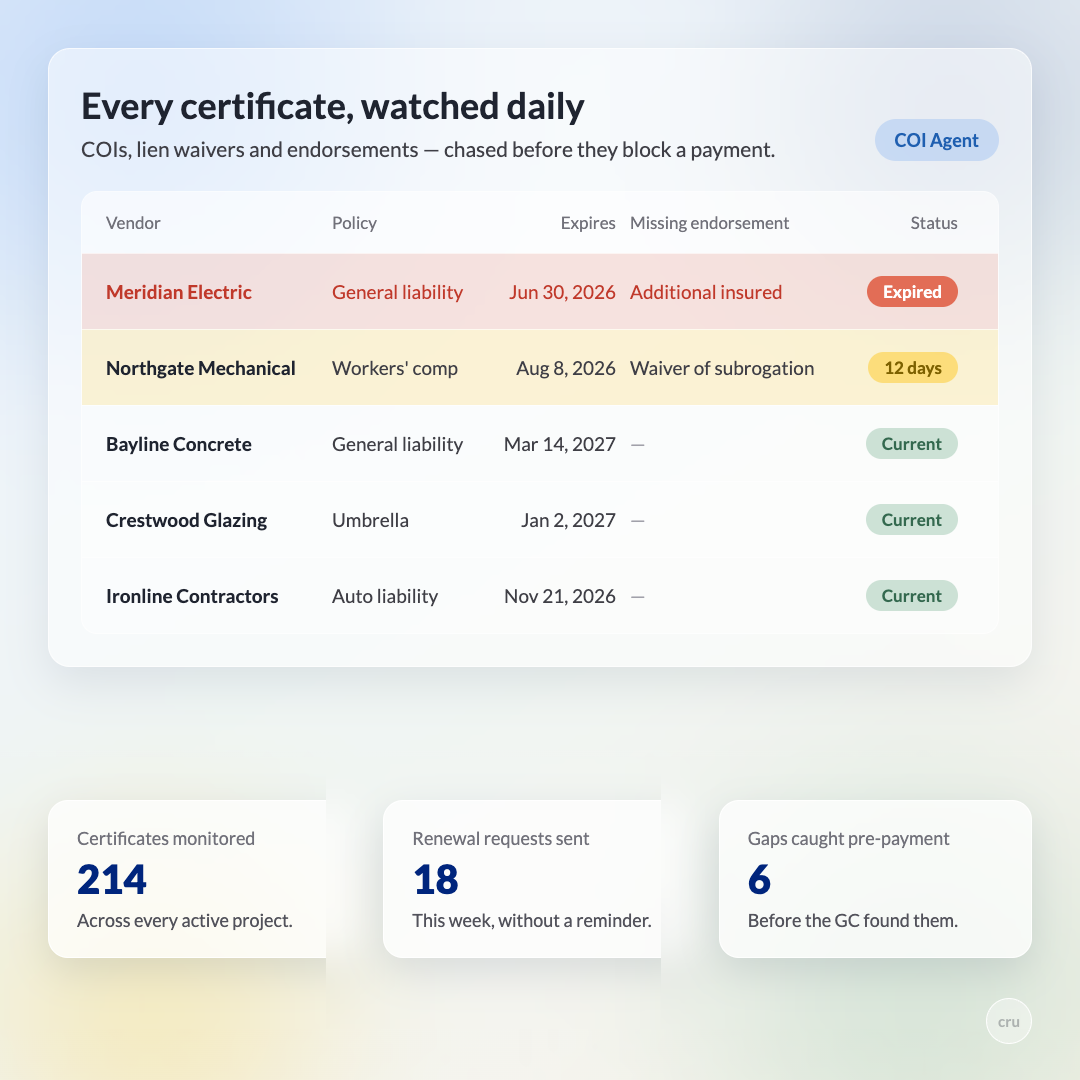
Cru's COI Agent tracks insurance, lien waivers, and licenses across every project and vendor, and flags expirations 30, 60, and 90 days out.
Book a demo →What automation actually changes
Lien waivers stop being a manual drafting exercise. Compliance platforms maintain statutory waiver templates for every state and generate the correct version automatically, pulling payment and project data straight from your accounting system instead of requiring someone to fill it out by hand. Automated, digitally-signed lien waiver workflows have cut the time from invoice approval to payment completion by roughly three weeks compared to manual processes, and contractors using this kind of automation report reclaiming 12 to 23 hours a month that used to go to chasing signatures and tracking submissions by hand.
Insurance tracking moves from reactive to proactive. Instead of a calendar reminder that someone eventually acts on, the system flags a certificate 30, 60, or 90 days before it expires, and can trigger the renewal request itself. Before a crew steps on site, the same system verifies every required certificate, including for lower-tier subs and vendors, is actually current.
The best version of this doesn't sit next to your accounting software, it sits inside it. A lien waiver that references the correct invoice amount automatically, insurance tracking that flags a crew member's expired license before they're scheduled on a job, retainage tracking tied directly to payment logic. Standalone compliance tools like Siteline, Built, and Rabbet specialize deeply in this and sync with your other systems. Integrated ERP platforms build the compliance logic into the same system that runs your accounting, trading some specialization for tighter accountability and less risk of the two systems drifting out of sync.
What to actually check before you commit to a platform
Confirm the tool has current, state-specific templates, since lien waiver law varies significantly by state and an outdated template creates real legal exposure. Confirm it pulls data directly from your accounting and project systems instead of requiring parallel data entry. Confirm alerts actually route to the right person by role, not just to a general inbox someone might check. And confirm the platform can produce a clean audit trail, what was verified, when, and by whom, since that record is what actually protects you if a dispute or audit happens.
Turn compliance tracking into an automatic check, not a monthly scramble
Free to connect, no commitment. See your first cash flow forecast in minutes.
Book a demoTL;DR
- Manual compliance tracking costs many subs 10-20 hours a month, and the cost of a single missed COI or lien waiver deadline is a work stoppage or a lost lien right, not just an inconvenience.
- Automated, digitally-signed lien waiver workflows can cut invoice-to-payment time by roughly three weeks.
- Standalone tools (Siteline, Built, Rabbet) specialize deeply; integrated ERP platforms trade some of that specialization for tighter accountability across accounting and compliance.
- Before committing, confirm state-specific templates, direct data integration, role-based alert routing, and a real audit trail.
See how Cru's COI Agent tracks compliance across every project and vendor →
Sources