Most subcontractors still run procurement on relationships and habit: a PM eyeballs the schedule, calls three or four vendors, and compares quotes that arrive by email, PDF, or the occasional fax, at different times, in formats that don't line up. That process was tolerable when material prices were stable. It's a real liability now that they aren't.
Why this got urgent in 2026
Materials run 40-60% of total project cost for most subs, so when prices move, margin moves with them. And prices are moving a lot. Nonresidential construction input prices rose at a 7.1% annualized rate in January 2026 alone, driven by tariff-affected materials like structural steel, aluminum, and copper wire. By mid-2026, some of those categories were tracking double-digit price increases year over year.
A 5% swing in material costs on a $500,000 project is $25,000 of P&L impact, and that's before counting waste. Overstocking, theft, and poor inventory tracking can add another 5-10% on top. None of that shows up as one dramatic event, it shows up as margin quietly disappearing across a dozen small decisions.
What an AI procurement agent actually does differently
It starts with the material list itself. The agent reads project plans and specs and generates an itemized list without someone building it from memory or a half-updated spreadsheet. From there it queries multiple vendors simultaneously, pulling real-time pricing, availability, and lead times, the same work that used to mean four phone calls now happens in minutes across dozens of sources.
Comparison isn't just lowest price. The agent weighs unit price, total cost, lead time, delivery fees, and historical supplier reliability, and can prioritize differently depending on the job: shorter lead times when timing is critical, lowest unit cost when margin is tight. Purchase orders then get timed to the schedule directly, concrete ordered for week 4 arrives in week 4, and multi-phase projects get staggered orders instead of a yard full of material sitting idle.
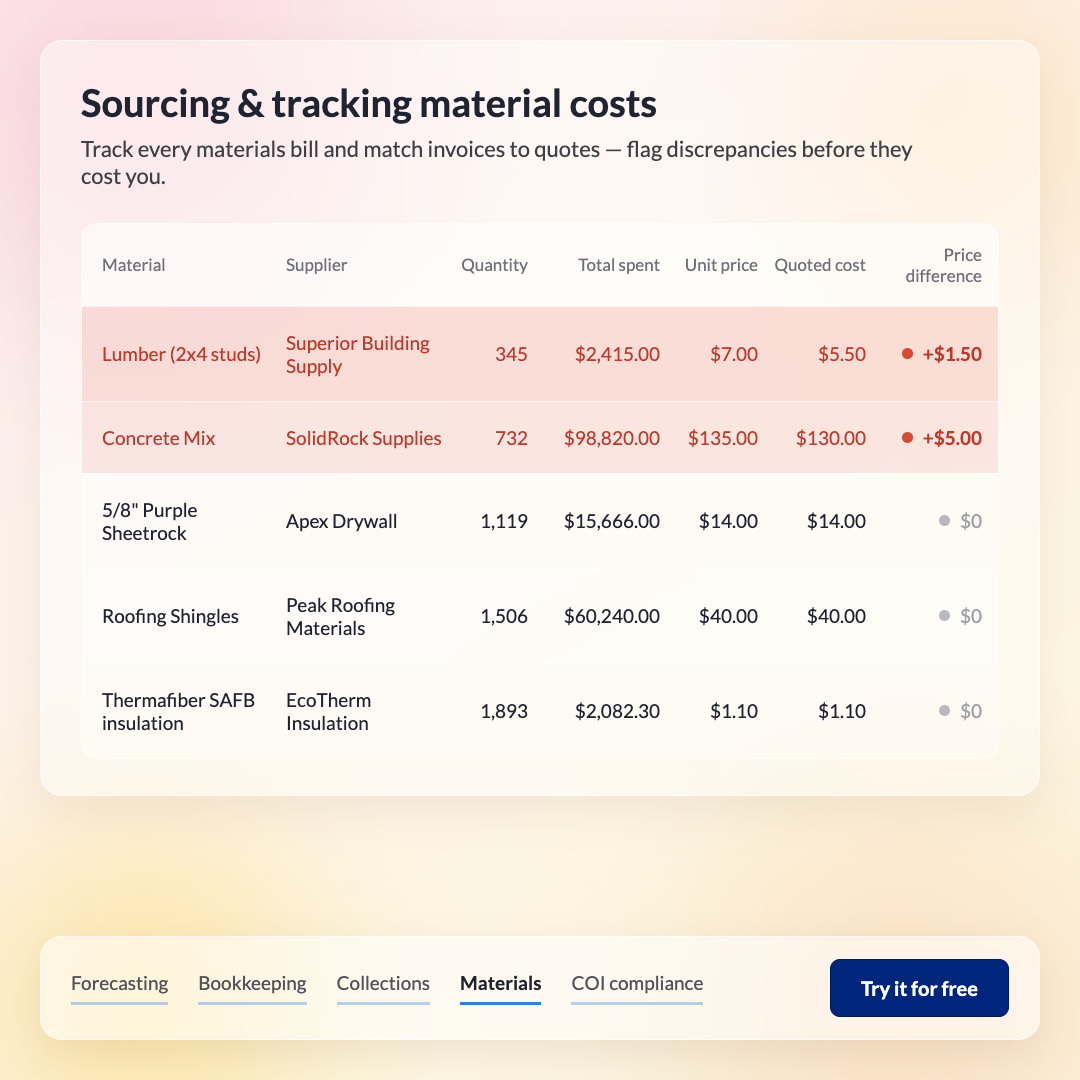
Cost tracking runs the same way in reverse. As invoices arrive, the agent checks them against the PO, flags a price or quantity mismatch, and updates the live budget same-day. If a line item comes in 5% over its threshold, that's a flag now, not a surprise at month-end.
The three moves that actually reduce cost, not just paperwork
Consolidate across projects. A sub running several jobs at once buying 500 units across all three costs less per unit than three separate 150-unit orders from three vendors. An agent with visibility across every active job can spot that consolidation opportunity automatically, something no single PM working one job would ever see.
Cru: Materials Agent
Catch a vendor overcharge before it hits your margin
Cru's Materials Agent checks every invoice against the purchase order and flags price or quantity mismatches the same day, not at month-end.
Book a demo →Time the order, not just the price. Seasonal pricing and market cycles affect cost more than most subs track manually. An agent with historical pricing data can model just-in-time ordering against bulk purchasing and recommend whichever minimizes total cost for that specific material and timeline, which matters more when tariff volatility makes next month's price a guess instead of a known number.
Score your suppliers with data, not memory. Over time an agent builds a record of every vendor's quote accuracy, delivery timeliness, and invoice discrepancies. That turns "we've always used this supplier" into an actual decision backed by which ones consistently deliver on time and at the quoted price.
What this is worth, honestly
Deloitte's research on data analytics and AI in construction estimates potential savings as high as 10-15% of total project cost from better procurement efficiency, reduced waste, and more informed purchasing decisions. Subs with the least visibility into cross-vendor pricing today tend to land at the higher end of that range; subs already running a tight process see more modest gains but benefit more from consistency than from any single big win.
An AI-native platform like Cru connects this directly to job costing and cash flow, so a purchase order doesn't just get placed, it updates the job's cost-to-complete and feeds the cash forecast automatically. That closed loop is the real difference between a standalone purchasing tool and procurement that's actually part of your financial system.
Connect procurement, job costing, and cash flow in one place
Free to connect, no commitment. See your first cash flow forecast in minutes.
Book a demoTL;DR
- Nonresidential construction input prices rose 7.1% annualized in January 2026 alone, driven by tariffs on steel, aluminum, and copper.
- A 5% material cost swing on a $500K project is $25,000 in margin, and that's before waste from overstocking or poor tracking.
- AI procurement agents compare vendors, time purchase orders to the schedule, and flag cost variances same-day instead of at month-end.
- Deloitte estimates 10-15% total project cost savings are available from better procurement data and automation alone.
See how Cru's Materials Agent connects procurement to job costing and cash flow →
Sources
- Nonresidential construction input prices rose at a 7.1% annualized rate in January 2026 alone
- double-digit price increases year over year
- Deloitte's research on data analytics and AI in construction estimates potential savings as high as 10-15% of total project cost