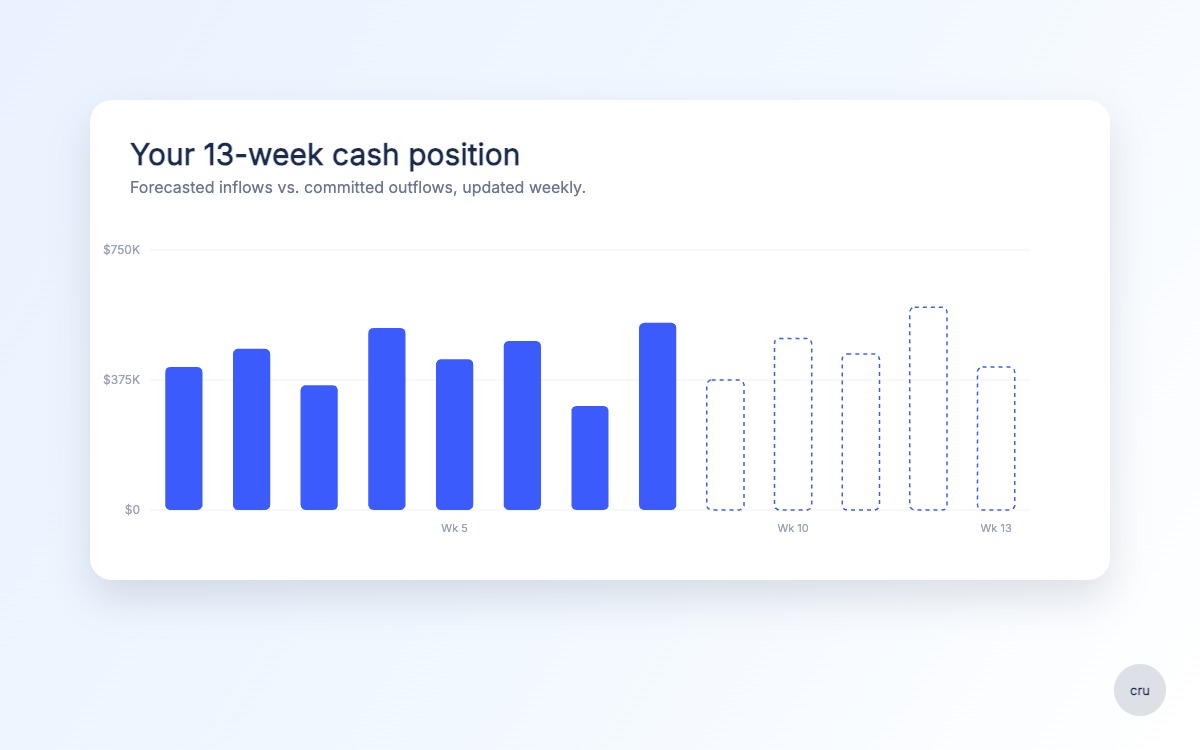
If your cash flow plan is "check the bank balance every morning," you don't have a forecast. You have a mood.
That approach works fine until it doesn't — until a GC sits on a pay app for three extra weeks, or a retainage release you were counting on slides to next quarter, or payroll lands the same week as a material deposit you forgot you owed. Subcontractors don't usually go under because the work wasn't profitable. They go under because cash arrived later than obligations did, and nobody saw it coming far enough in advance to do anything about it. A rolling 13-week cash flow forecast is the tool that closes that gap, and almost nobody in the trades runs one properly.
Why bank-balance management fails on real jobs
Checking today's balance tells you where you stand right now. It tells you nothing about the six-figure swing coming in week 7 when two projects hit retainage release at the same time your equipment lease renews. Construction cash flow isn't smooth — it moves in lumps tied to milestones, change order approvals, and payment terms that are rarely honored to the day. A sub billing $2-4M a year can easily have $150-300K of committed payroll and material obligations sitting between today and the next big draw, with no visibility into whether the draw actually lands before the obligations do.
Spreadsheet-based forecasts try to solve this, and for a week or two they do. Then a change order gets approved, a GC pushes a payment date, a new hire shows up on payroll, and the spreadsheet is stale. Nobody goes back and rebuilds it because rebuilding it takes half a day, so it sits there giving false confidence until the next crisis makes someone open it again.
Cru: Cash Flow Agent
See the six-figure swing coming before it hits
Cru builds your 13-week forecast from real AR, AP, and payroll data, so retainage releases and payment gaps show up weeks before they become a crisis.
Book a demo →What a real 13-week forecast looks like
Why 13 weeks. Thirteen weeks is one quarter — long enough to see a retainage release, a slow month, or a seasonal dip coming with enough runway to act on it, short enough that the inputs (contract values, payment terms, current AR) stay reasonably accurate without needing to model a whole year of assumptions. Go shorter and you're just looking at what you already know. Go longer and the forecast turns into guesswork.
The inputs that actually matter. A usable forecast pulls from AR aging (what's billed and how old it is by GC), committed costs (subcontracts, material POs, equipment rentals), payroll on a fixed cadence, and a retainage schedule tied to actual contract close-out dates rather than a generic "5% held back" assumption. Miss the retainage schedule specifically and the forecast will be wrong exactly when it matters most — right before a big release you were banking on.
Why it has to be rolling. A forecast built once in January and never touched again is a historical document by February. The point of "rolling" is that week 1 drops off and a new week 13 gets added every week, with actuals reconciled against what you predicted so the model gets more accurate over time instead of drifting further from reality.
Why spreadsheets go stale within days. Every input — AR aging, committed costs, payroll, retainage — lives in a different system or a different person's head. A spreadsheet forecast requires someone to manually pull all of it, reconcile it, and re-enter it weekly. In practice that update gets skipped when things get busy, which is exactly when the forecast is needed most. Automated forecasting tools pull directly from AR, AP, and payroll data so the 13-week view updates itself instead of depending on someone remembering to do it.
What still needs a human
No forecast — automated or not — replaces judgment on the two inputs that are inherently uncertain: whether a specific GC actually pays on the date their contract says they will, and whether a change order in negotiation will get approved at the number you billed. A good system surfaces the data and lets you apply that judgment; it shouldn't pretend to know things you don't. Cru's forecasting tools show you the range of outcomes based on payment history, not a false single number dressed up as certainty.
Where this fits next to what you might already use
Most subs today are choosing between three options: a manual Excel model (flexible, but stale within a week and dependent on one person maintaining it), a general accounting package's cash flow report (accurate on history, weak on forward-looking milestone and retainage modeling), or a purpose-built forecasting tool. Siteline and similar platforms have pushed the industry toward automated, milestone-aware forecasting for billing and collections specifically. Cru approaches the same problem from the AR/AP/payroll data side, aiming to keep the 13-week view current without manual rebuilds.
Keep your 13-week forecast current automatically
Free to connect, no commitment. See your first cash flow forecast in minutes.
Book a demoTL;DR
- A 13-week rolling forecast — one quarter of visibility — is long enough to see retainage releases and slow months coming, short enough to stay accurate.
- The four inputs that matter: AR aging by GC, committed costs, payroll cadence, and a real retainage release schedule (not a flat 5% guess).
- Spreadsheet forecasts go stale within days because every input lives in a different system and someone has to manually reconcile them weekly.
- "Rolling" means the model updates every week — old week drops off, new week thirteen gets added, actuals reconcile against predictions.
- Automation doesn't replace judgment on GC payment behavior or change order approval odds — it just keeps the underlying data current so your judgment has something reliable to work from.
See how Cru's Cash Forecasting Agent keeps your 13-week view current automatically →